
Composition in Photography
Recently I went to see the David Hockney Exhibition at the Royal Academy of Arts. Firstly, because I love the bold way that he paints but also to see what can be learnt from his style of composition.
Composition can be defined as a means of selecting appropriate elements and arranging them within the picture space to communicate the artist’s (or photographer’s) ideas, and feelings effectively to the viewer. Placing elements you have selected within your painting/photograph is very important. Composition can create either a strong and interesting piece of work, or a weak and confused piece.
There is no doubt in my mind that Hockney knows exactly how to draw the viewer to particular elements within his paintings. Whether using strong colours, lead-in lines or by simply placing points of interest within a rules of third grid Hockney keeps it simple (when you know how) when it comes to composition.
Through composition, and having a main focal point, Hockey controls which part of his picture the viewer is to linger over. Once a definite focal point is established, the viewer can be lead either directly or indirectly through the art. The use of light and dark contrasts also emphasises the center of interest.
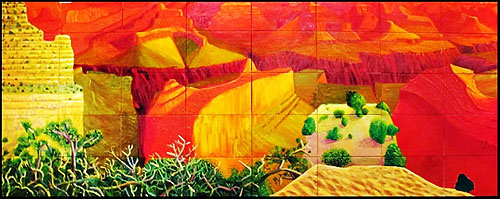
A sneaky shot I managed to take of David Hockney’s 40 Canvas Artwork
So as a photographer, what can we learn from this?
The 4 main elements of composition are:
Image area: This is the surface within the four borders of your image that is used for the photograph. The image area will help you determine placement of objects, and how big they should be.
Depth: This is the illusion of distance or a third dimension. Depth creates a three dimensional effect, making objects feel closer, or further away. The finished result will not appear flat on the paper or canvas if depth is created. By changing your depth of field or by creating a foreground, a mid-ground and a back ground will do this
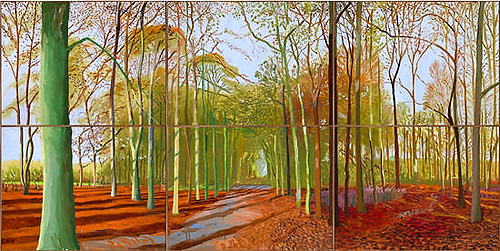
Line: The line or direction the viewer’s eye takes to go through the image. The objects within the picture should lead the eye to the focal point. When photographs are viewed, most people will begin in the bottom left corner, and continue through the picture to the right. A good composition will not allow the viewer to keep going right, all the way off the page. The viewer should be lead back into the photograph in a flowing motion.
Value: This is the lightness, or darkness of an area, or a shape within the picture. It is also used to create the over-all feel of the image.
Wedding Photography Training, Portrait photography Training, Lifestyle Photography Training, Beginners Photography Training